
Two varieties, one clear rationale. Dense cloeziana for heavy-duty applications and salt water, lighter grandis for above-ground structures. The figures will help you choose the right pole for the job.
Each species excels in its own field. Dense Cloeziana is suitable for heavy-duty applications and saltwater. Lighter, potentially treated Grandis is suitable for general and above-ground structures. The figures are intended to help you choose the right pole for the job, not to rank one species above the other.
| Properties | Eucalyptus cloeziana | Eucalyptus grandis |
|---|---|---|
| Strength class | D70 (SHR Wageningen 2024) | D50 |
| Density (kg/m³) | 875 to 950 | 695 |
| Modulus of rupture (MPa) | 141 | 108 |
| Modulus of elasticity (MPa) | 19.521 | 15.772 |
| Compressive strength parallel to the grain (MPa) | 75,1 | 59,9 |
| Hardness of the side grain (N) | 8.296 | 5.108 |
| Shear strength (MPa) | 11,8 | 11,4 |
| Preservation | Not necessary – naturally durable | Pressure-treated, Tanalith E standard |
| Introduction | Heavy-duty use and salt water | Above-ground and lighter-duty applications |
Average test values. Source: Banks, C.H., 1954, revised 1973, updated 1976, Bulletin 48, Department of Forestry, South Africa. Strength class for Cloeziana according to SHR report 23.0371 (2024), EN 338 and EN 14251.
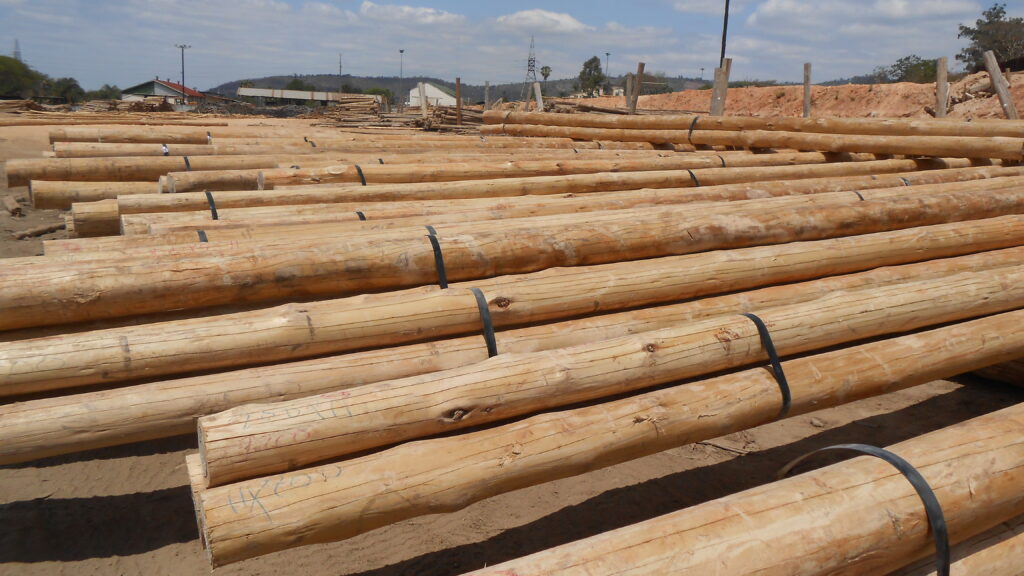
Marine pile foundations, jetties and quay structures, exposure to salt water and tidal action, heavy structural loads, hydraulic engineering.

Verandas, pergolas and lapas, fencing and landscaping, lightweight roof structures, general above-ground structures.
We’ll work with you based on your specifications and load requirements. Email your enquiry to sales@woodsolutions.nl or arrange a meeting.
To provide the best possible experience, we use technologies such as cookies to store and/or access information about your device. By consenting to these technologies, we may process data such as browsing behaviour or unique identifiers on this site. If you do not give your consent or withdraw it, this may adversely affect certain features and functionality.